
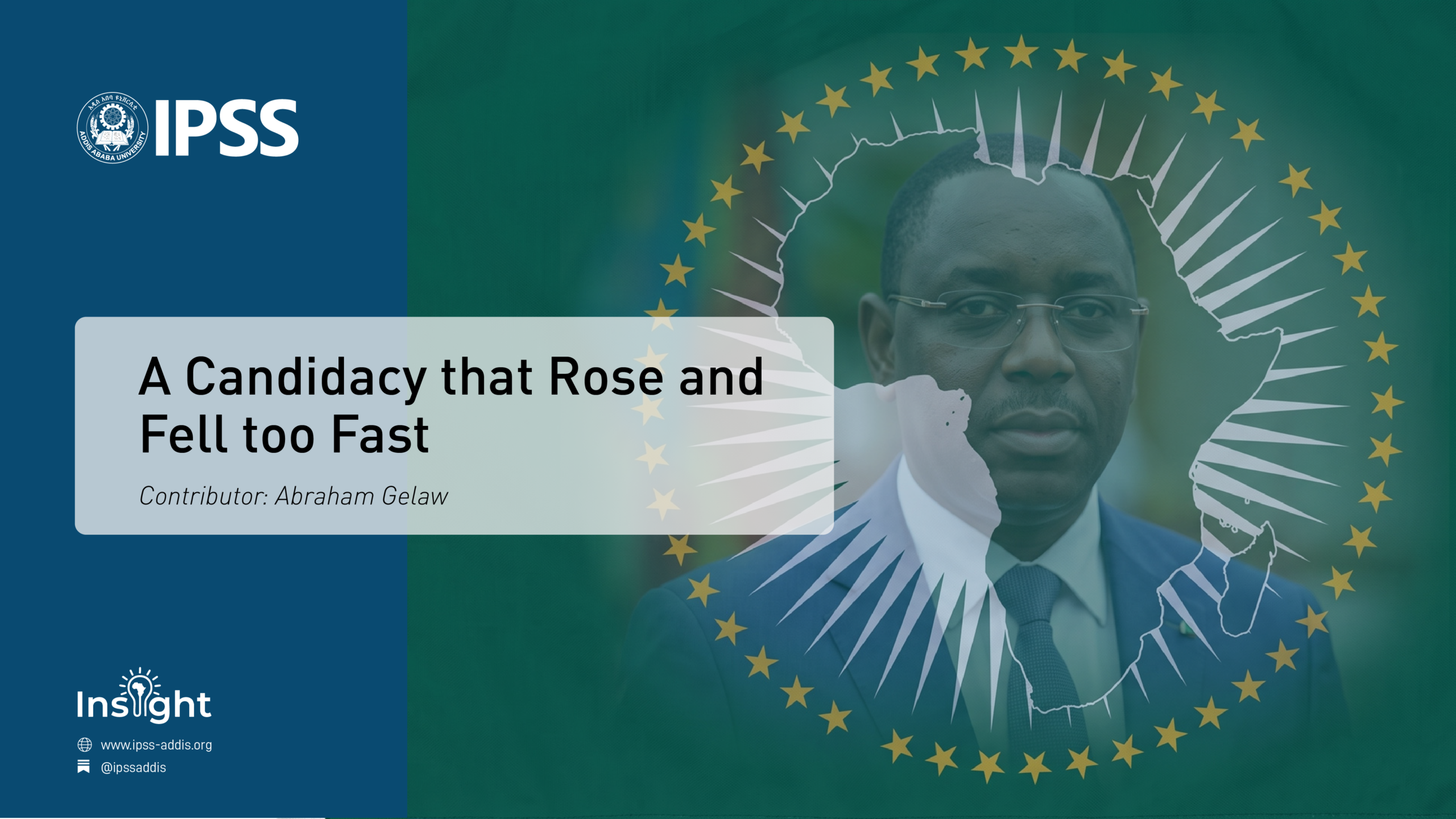
For a brief moment in late March 2026, it seemed like Africa had made up its mind on the candidacy for the next Secretary-General of the United Nations. The African Union Commission had backed Macky Sall, presenting him as the continent’s choice to contend for one of the world’s most demanding diplomatic roles and circulated a draft decision to AU member states under a ‘silence procedure’, meaning, the decision would be deemed adopted unless member states objected before the deadline date, but fourteen member states objected and six requested more time, thereby breaking the silence procedure. Following this, the draft decision was not adopted. On the surface, the decision to process the candidacy confirmation seemed logical: Sall was a former head of state with regional visibility, years of political experience, and a reputation for maintaining relative stability in Senegal.
But what first appeared to be a moment of continental consensus quickly revealed itself to be far less solid. The AU Commission send a ‘draft Decision’ on approving the candidacy of H.E Macky Sall for the position of Secretary General of the UN, as it has no power to confirm such candidacy by itself. Within days, questions began to emerge, signaling disconnect between the member states and the AU Commission over procedure on who got the power to circulate a draft decision on such sensitive candidacy matters, rushed timing, and political acceptability of the candidate himself. Some states requested for more time, others objected more openly, and the endorsement that had been framed as African unity began to look more like an uneasy compromise. Reports showed that countries such as Nigeria and Senegal opposed the endorsement openly, exposing the fragility behind the AU’s public backing. What was meant to project confidence instead revealed division.
Part of that resistance was tied to Sall’s own political record. While he left office with the credentials of an experienced statesman, his presidency also carried controversies that were difficult to ignore. In the years leading up to the Senegalese election, political tensions escalated sharply. Opposition protests were met with violent crackdowns, dozens were killed, and concerns mounted over whether Sall intended to seek a disputed third term, an idea that triggered widespread criticism before he eventually stepped aside.
These issues matter because the office of the UN Secretary-General demands more than diplomatic experience. It carries moral weight. The person who occupies that office is expected to embody, at least symbolically, the values the UN claims to defend: accountability, respect for democratic norms, and moral credibility. No leader has a flawless record, and perfection is not the standard. But there is a difference between the normal complexity of governance and a record that sits in tension with the principles of the office being sought. In Sall’s case, I see that tension too clear to ignore.
The deeper problem, however, was not only the candidate, it was the process. Endorsing a candidate for UN Secretary-General is one of the most symbolically important diplomatic choices the AU can make. It signals to the world what kind of leadership Africa wants to put forward. Yet, the endorsement process appeared rushed, with visible cracks emerging almost immediately. Nigeria and Senegal’s objection was not just a procedural disagreement; it was evidence that key voices had not been fully brought into consensus before the announcement was made. That matters because when the AU presents internal division as unity, it weakens the very credibility it seeks to build.
A Moment to Reflect
The swift rise and equally swift unravelling of Sall’s candidacy offers more than a diplomatic lesson, it offers a moment of reflection for African multilateral politics.
Too often, when prestigious international positions open up, the instinct is to turn to familiar names: former presidents, high-profile statesmen, and politically recognizable figures. This approach is understandable as former heads of state carry visibility, networks, and institutional experience. But visibility alone does not guarantee suitability. The role of the UN Secretary-General is not ceremonial. It demands diplomatic patience, political independence, and the moral authority to speak credibly on issues of peace, governance, and human rights. That kind of authority cannot rest on reputation alone; it must be grounded in trust.
When the selection process prioritises name recognition over careful evaluation, it risks reducing merit to political convenience. That appears to be what happened with Sall’s candidacy. Instead of asking whether the candidate best embodied the principles of the role, the process seemed driven by momentum and elite consensus-building. The result was predictable: hesitation from member states, questions from observers, and an endorsement that failed to command the confidence it was supposed to project.
The cost of this kind of miscalculation goes beyond one candidacy. Africa’s influence in global institutions depends not only on representation but on credibility. When the continent speaks with divided voices on matters of global leadership, its bargaining power weakens. What could have been an opportunity to project diplomatic maturity instead becomes a reminder of unresolved internal fractures.
This is why the Sall case matters. It exposes the gap between the AU’s aspiration for collective diplomatic influence and the realities of how that influence is sometimes exercised. Unity cannot be simply announced; it must be built through transparent consensus, honest evaluation, and the willingness to prioritise institutional credibility over political expediency.
The Way Forward
The setback over Makcy Sall’s candidacy should not be seen simply as a failed endorsement. It should be treated as an opportunity to rethink how Africa approaches global leadership nominations.
If the continent wants to strengthen its voice in institutions like the UN, then the process of selecting candidates must become more deliberate, transparent, and merit-based with clear and pre-determined objective criteria to refine applicants during the process. That means, evaluating candidates not only for experience, but for the credibility of their records, the consistency of their values, and their ability to command respect beyond regional alliance.
It also means moving beyond the habit of relying on familiar political figures by default. Africa is full of capable diplomats, jurists, multilateral negotiators, and reform-minded leaders whose experience may be more aligned with the demands of international institutions than of former high-level politicians. Expanding the pool of candidates would not weaken Africa’s diplomatic standing, it would strengthen it.
Most importantly, the AU must recognise that credibility is part of influence. The continent deserves representation in global leadership, but meaningful representation is not achieved by simply putting forward an African name. It is achieved by putting the right candidate through a process that inspires confidence both within Africa and beyond.
There will be other opportunities, other nominations, and other moments when Africa can shape the leadership of global institutions. The question is whether those opportunities will be handled differently. If the lesson of this case is taken seriously, future endorsements can reflect careful judgment rather than rushed consensus, merit rather than familiarity, and confidence rather than contradiction.
Because in the end, Africa’s goal should not be to place just any African at the helm of the United Nations. It should be to put forward a leader whose credibility strengthens the continent’s voice the moment their name is announced.
Disclaimer: The views expressed in this Insight reflect the perspectives of the contributor and do not necessarily represent the official position of Institute for Peace and Security Studies.
 |
Contributed by Abraham Gelaw Researcher |