
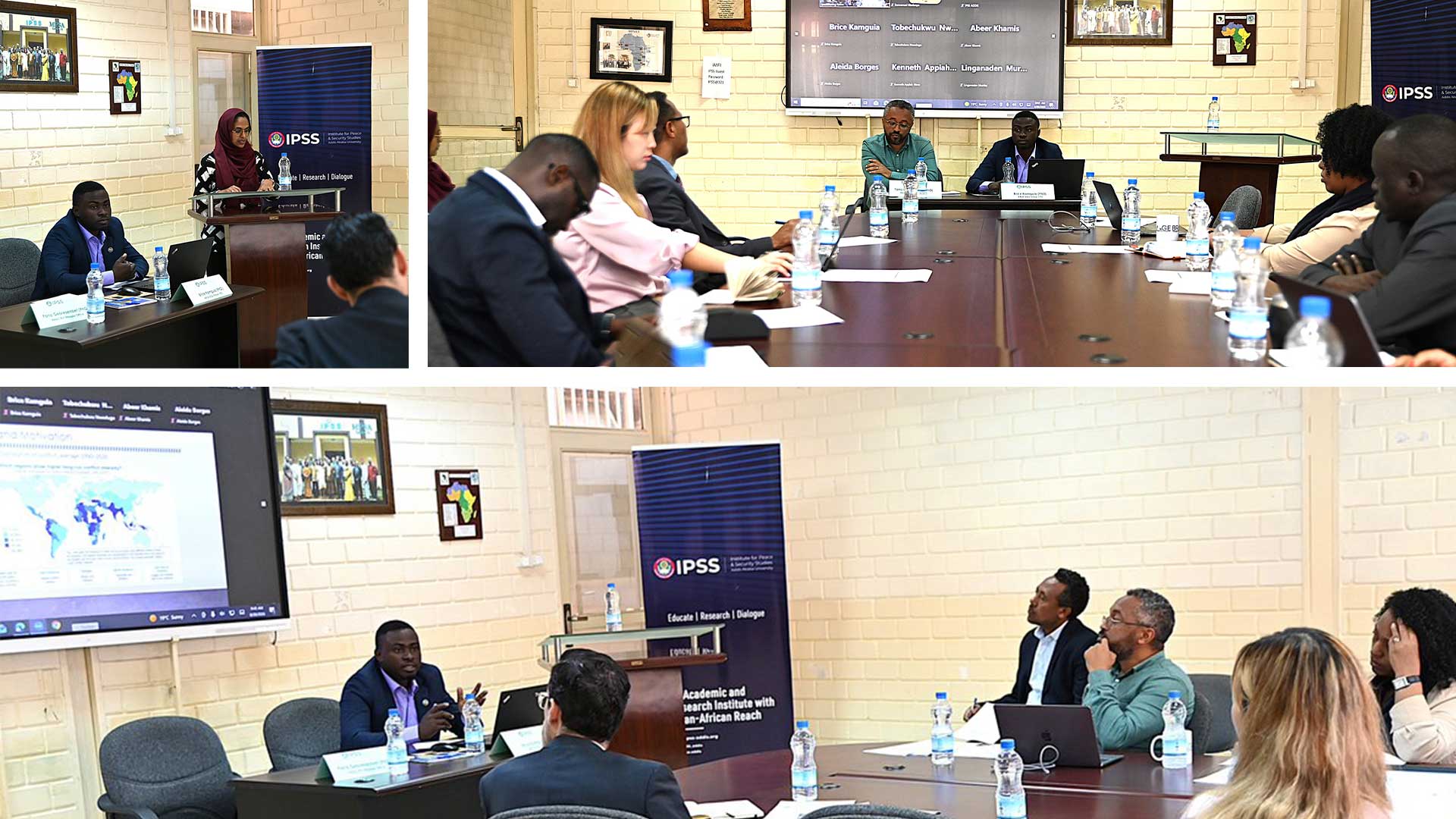
On 28 August 2026, the Institute for Peace and Security Studies (IPSS), in collaboration with the African Leadership Centre (ALC) and Kings College London, hosted a briefing session on “Energy Justice and Conflict in Sub-Saharan Africa: Does Fair Energy Access Promote Peace?” as part of the third NCIRI Seminar Series. The hybrid event brought together researchers, policy experts, and practitioners to examine the relationship between equitable energy access, conflict, governance, and peacebuilding in Africa.
ARUA 2026 Research Fellow Brice Kamguia (PhD) presented research examining whether energy justice contributes to reducing the likelihood and intensity of armed conflict. His analysis considered the distributive, procedural, and restorative dimensions of energy justice and found a significant association between higher energy justice and lower levels of conflict. The presentation also highlighted differences across countries based on institutional quality, economic development, energy justice, and conflict intensity.
Expert discussants Fana Gebresenbet (PhD), Head of Rift Valley Institute’s (RVI) Ethiopia Office, and Emmanuel Y. Gbolonyo, School of Economics, University of Cape Town, South Africa, critically engaged with the findings. Their reflections raised important questions around the measurement of energy justice, data quality, causality, regional and country-level differences, and the role of political mobilization in transforming energy inequalities into grievances.
The discussion drew particular attention to Ethiopia, where regional disparities in electricity access and infrastructure demonstrate how energy inequality intersects with broader political and socioeconomic dynamics. Participants also explored the role of energy access in employment, livelihoods, development, and peacebuilding, as well as the implications of Africa’s energy transition and energy mix.
The session concluded with a call for more context-specific research, stronger causal analysis, reliable data, and inclusive energy policies that address inequality while supporting sustainable peace and development across Africa.