
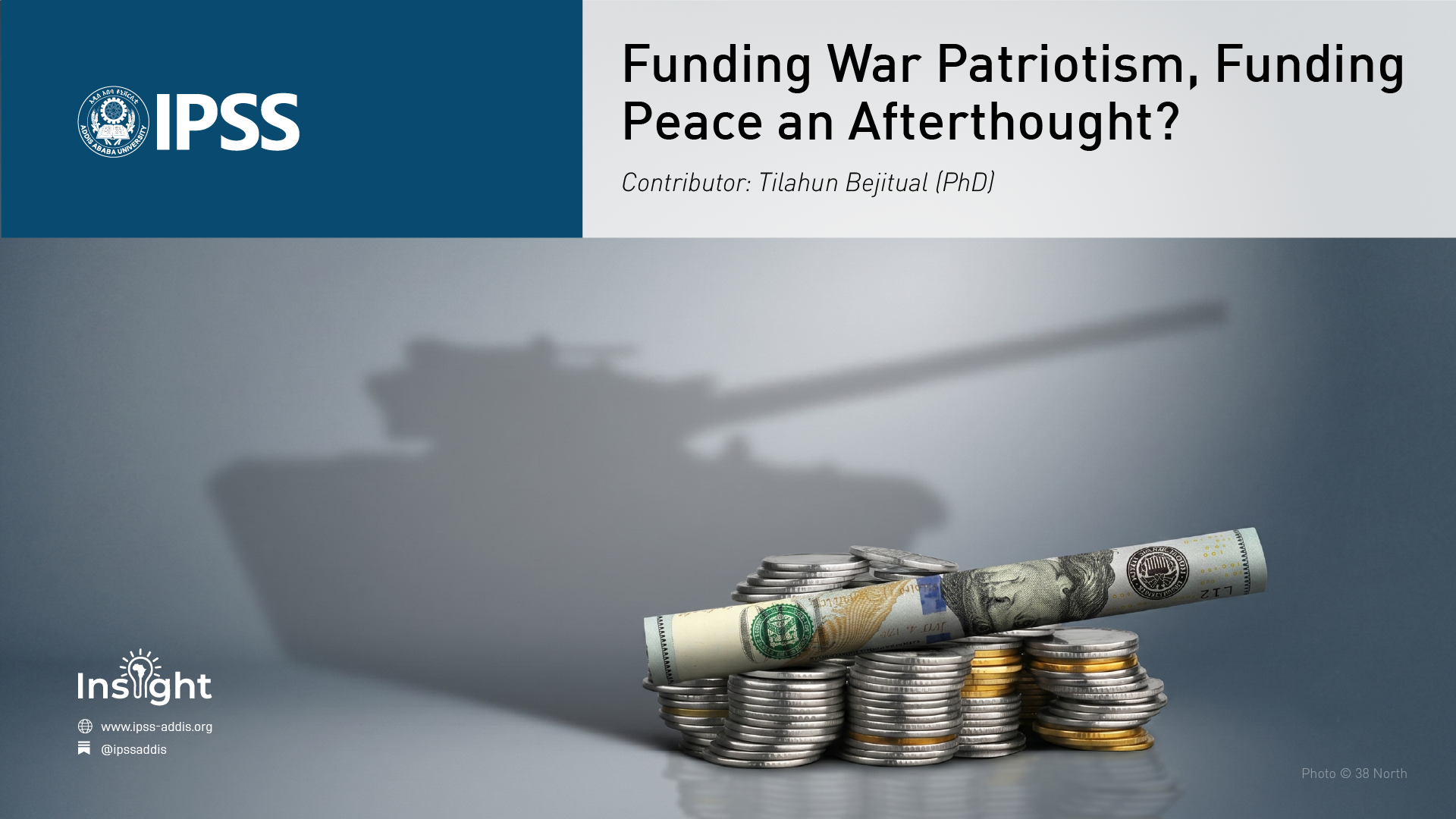
The global landscape features a troubling paradox: mobilizing billions to wage war is readily embraced as an act of patriotism and state sovereignty, while financing the foundations of peace often remains an underfunded afterthought. From global defence expenditures, which shows an incessant increase for over a decade, to local resource mobilization, states as well as communities almost routinely demonstrate the verve and appetite, which often come packaged in the shape of impeccable rationale of sovereignty, national interest and ‘just war’ rhetoric, for funding war and destruction, only to face severe fatigue and economic paralysis when the decisive time comes to reconstruct.
This dilemma is visible across Africa, particularly within the East and Horn of Africa region. In Ethiopia, the devastating conflict between the TPLF and the Federal Government that erupted in November 2020 left a trail of deep scars. Massive civilian casualties, severe food insecurity, and the widespread displacement of populations across the Tigray, Amhara, and Afar regions have severely fractured the country’s socio-economic fabric. Yet, as the arduous task of Post-Conflict Reconstruction and Development (PCRD) takes centre stage, an uncomfortable question lingers: why does the private sector, an inevitable victim of war, struggle to shift from the frantic mobilization of the war economy into an active, strategic partner for sustaining peace?
The Trap of Telethon Philanthropy
During active hostilities, the private sector is frequently called upon to demonstrate national solidarity to fight the ‘existential and just war’. In Ethiopia, this has historically manifested as ad-hoc, highly publicised telethons where businesses and prominent figures pledge millions to support national causes. While these gestures demonstrate temporary alignment, they later reflect a business-as-usual strategy that falls lamentably short of what sustainable peace demands.
Treating the private sector as a mere corporate donor or an ad-hoc financial reservoir misjudges its true potential and systemic vulnerability. The reality is that businesses are among the primary casualties of war. For instance, the conflict in northern Ethiopia, which isn’t over yet, claimed the lives of many, resulting in deep physical and financial devastation. Studies show that businesses operating within war-affected zones endure cycles of extortion, systemic abuses, and abductions by warring factions while some businesses make the most of uncertainties and instabilities during times of crises.
Given the intricate dynamics of actors at times of war, one of the core challenges in transitioning from war to peace is the complexity of shifting the underlying economic motivations of such actors. Broadly speaking, wartime environments are divided into three overlapping systems: i) the war economy, which refers to the formal and informal allocation of resources explicitly to wage and sustain active combat; ii) the shadow economy, the opportunistic space where actors profit directly from the conflict, operating either legally or illegally through clandestine markets, smuggling, or war profiteering; and, iii) the coping economy that is about the strategies adopted by ordinary citizens and local businesses trying to survive on existing assets amidst widespread devastation.
In view of these layers of economy, PCRD cannot simply be a nostalgic attempt to recreate or restore the pre-war normalcy. Instead, true recovery requires systematically dismantling the highly lucrative structures of the war and shadow economies, which in turn necessitates an immense and bold shift in orientation from all stakeholders.
It is important to note that where businesses position themselves across these three economic tiers heavily dictates their willingness and appetite to embrace peace. To wit, a business that has adapted to profit from shadow-market scarcity or war-related procurement will either sabotage or resist a transition to a regulated, peaceful (market) economy. On the other hand, those trapped in the coping economy are often too financially depleted and lack agency to invest in long-term peace initiatives without external support of stabilization.
Such societal depletion tragically extends to powerlessness to make any meaningful impact in the human development of war-affected zones. The tragic war in Northern Ethiopia, for instance brought about devastating toll on human capital and infrastructure with severe consequence on generations to come. According to reports, the violence has become the primary driver of Ethiopia’s education crisis, directly accounting for roughly 70% of the country’s out-of-school children. Needless to say, persistent insecurity and widespread school closures that disrupts school attendance means leaving millions of children and young people vulnerable, which paralyses the very social infrastructure required for long-term regional stability.
Moving Beyond Pledges
If the private sector is to move past sporadic and at times superficial fundraising campaigns for show of solidarity during active wars or during PCRD toward genuine and sustainable investment in infrastructures of peace, a structural shift is required. Rather than treating peace as a charitable afterthought, public and private actors must treat peace as a strategic, co-funded investment. To effectively mobilize the private sector into the broader peacebuilding as well as PCRD arithmetic, four foundational and interrelated pillars must be established:
- i) Shift in corporate worldview: The private sector should integrate itself into peacebuilding with a “new corporate worldview”, toward treating peace as its intrinsic motivation so much so that “business should be viewed and view itself as a stakeholder in sustainable development”. However, just as companies engage in “greenwashing,” scholars warn against “peace washing,” using peace as a marketing buzzword without creating actual impact. Avoiding this requires a healthy business ecology built on supportive laws and joint stakeholder deliberation to ensure genuine peace dividends.
- ii) Security assurances and de-risking investments: Businesses cannot invest in peace if they fear a sudden relapse into conflict. Bringing the private sector, particularly in historically war-affected regions, fully on-board requires deliberate policy interventions that guarantee personal safety and property security. Business owners need concrete assurances that they will not face violent retaliation or a secondary wave of asset destruction from potential clashes.
iii) Reciprocal public-private partnerships: While international donors, humanitarian agencies, and regional governments focus heavily on immediate emergency relief, basic service restoration, and repairing damaged physical infrastructure, the state must introduce rewarding mechanisms for local business communities. Governments should offer targeted tax incentives, favourable credit lines, and regulatory concessions to businesses that actively inject capital into highly disrupted regions.
iii) Economic reintegration as a business priority: The ultimate linchpin for preventing a return to conflict is the economic absorption of vulnerable demographics. The private sector is uniquely positioned to drive the reintegration of former combatants, as well as the millions of youth displaced from the school system, by creating sustainable livelihood. Through targeted skilling and reskilling programs, businesses can transform a fractured and disenfranchised generation into a productive workforce. The long-term stability of the region hinges entirely on the capacity of local job markets to absorb this workforce, preventing marginalized youth from falling back into violent patterns of conflict, displacement, and forced migration.
The Way Forward
The paradox of funding war over peace can only be broken when we stop treating peace as a passive state of non-violence and begin treating it as an active economic asset. For Ethiopia and the wider Horn of Africa, continuing down the path of ad-hoc patriotic war campaigns followed by lacklustre peace fundraising will only perpetuate a cycle of economic fatigue and fragility. To build a resilient future, the public and private sectors must collaboratively address the uncomfortable structural realities, asking the following questions: How do we revive a domestic business community that is itself deeply fractured along ethnic lines? How do we motivate business actors to shift their responsiveness to war mobilization to investments on peace-building? The answers require looking past short-term telethons toward comprehensive, state-backed, and structurally secure public-private partnerships through such initiatives as business for peace to mobilize toward a renewed corporate worldview of doing business. This will allow to maximize the “business benefits of peace” while reducing the “business costs of conflict” Only when funding peace or investing in infrastructures of peace with intentionality is viewed as the expression of civic duty, corporate principle and business survival can the region achieve sustainable peace, stability and prosperity.
This piece draws on insights from a conference compendium I edited: “Regional Conference on Business for Peace in Ethiopia and the Horn” (2023), convened by Initiative Africa and the Red Sea Cultural Institute. You can read the full compendium and my introductory foreword at the link below: https://initiativeafrica.net/wp-content/uploads/2024/11/Business-for-Peace-2023-_compendium-1-2.pdf
Disclaimer: The views expressed in this Insight reflect the perspectives of the contributor and do not necessarily represent the official position of Institute for Peace and Security Studies.
 |
Contributed by Tilahun Bejitual (PhD) Lead Researcher |