
In Rethinking Transitional Justice for the Twenty-First Century: Beyond the end of history, Dustin Sharp explores in chapter three the question to whom transitional justice is aimed at by placing emphasis on victims and communities’ transitional justice initiatives intends to serve. He presents transitional justice initiatives and practices by arguing for careful reflection about both the “who” and the “how” of transitional justice. The chapter further provides a comprehensive overview of the inevitable link between the “local” and “the global” dimensions of transitional justice and argues for a better global-local balance in transitional justice.
Dustin’s central argument that local ownership and practices is essential in post conflict peacebuilding, transitional justice and reconciliation traditions was particularly convincing. He supports this argument by detaching himself from idealistic transitional justice interventions to more pragmatic and context-specific approaches that gives greater importance to local ownership, agency, priorities, values and practices.
Indeed, the concepts of local ownership and local knowledge in transitional justice are grounded in the idea that meaningful and effective justice after mass atrocities is best achieved through active local participation and leadership. As a form of justice implemented within the very societies where mass atrocities occurred, local transitional justice is particularly essential because it is a form of justice that is close to victims and their lived experiences.
While international actors can draw on local knowledge of context and culture (which they often do not possess), their ability to reform legal and political systems, hold perpetrators accountable and provide reparations to victims remains limited. For instance, the creation of hybrid tribunals and funding of transitional justice processes such as truth commissions without customary, locally rooted transitional justice processes that solicits the views of victims on how post conflict justice should best be achieved, cannot produce sustainable results.
As a matter of fact, no matter how involved international actors are in transitional justice and peace processes, local societies and not international actors enjoy the results of the processes. They also bear the consequences in case of its failure. Consequently, only locally owned initiatives can guarantee long term results. Former UN Secretary-General Kofi Annan supported this argument by asserting that “no rule of law reform, justice reconstruction, or transitional justice initiative imposed from the outside can hope to be successful or sustainable.”
One of the biggest challenges of local ownership in transitional justice however, remains its compatibility with international norms. Although transitional justice is rooted in international human rights law as it aims at reinforcing respect for human rights and the rule of law, local ownership, practices, and values are often incompatible with the very international human rights law that gave birth to transitional justice. Moreover, local capabilities and willingness to effectively and impartially serve justice and achieve reconciliation is paramount but not always easy to find in local societies making it difficult to implement local ownership in transitional justice.
Another challenge associated to local ownership is the lack of financial, human resources and adequate institutions necessary for justice, reconciliation and peacebuilding. Consequently, and while Dustin’s arguments on local ownership are adequate and relevant as it gives different perspectives on transitional justice and its contemporary significance, local ownership alone, given the above challenges, is unrealistic and no panacea in post conflict justice, reconciliation and peacebuilding.
The involvement of global actors in most local conflicts dynamics is today inevitable. As a result, global-local balance is required in order to efficiently address the complex nature of a given situation. Moreover, the inefficiency of local judicial systems often necessitates international involvement through the creation of international hybrid courts. A number of examples are notably highlighted in the chapter to support this claim such as the creation of international hybrid tribunals in Kosovo, East Timor, Sierra Leone, and Cambodia.
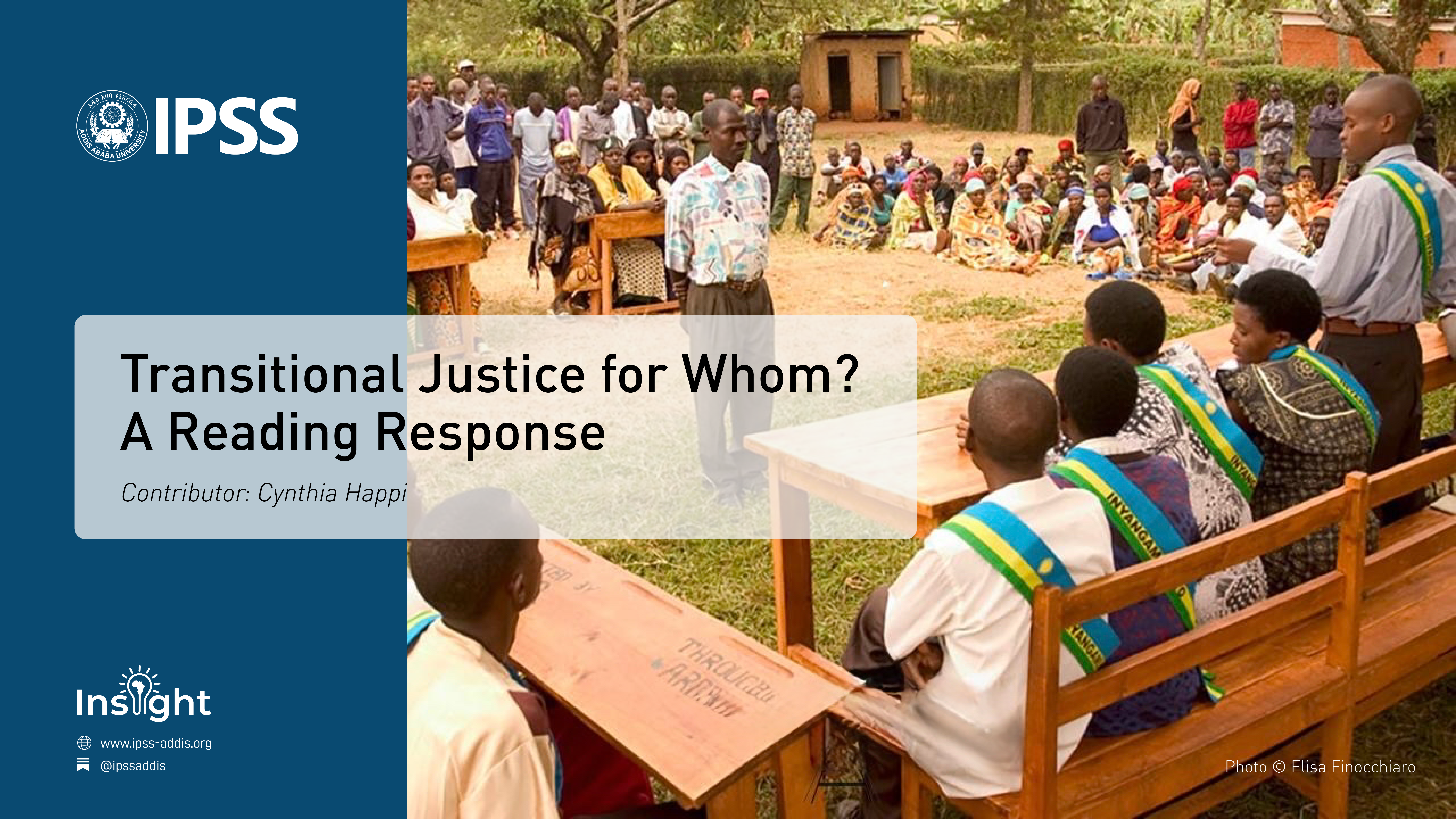
Dustin further examines the Gacaca process in Rwanda, presenting it as a compelling example of the potential for local ownership within transitional justice frameworks, while acknowledging inherent tensions between global norms and local practices. However, this assessment does not sufficiently account for the extent to which the process reproduced and, in some cases, deepened existing social divisions. The Gacaca court system was established by the Rwandan government in order to bring justice and reconciliation at the grassroots level following the violence of the 1994 genocide. As a result, judges were elected at the local level to hear untried genocide cases and defendants were brought before community members and judges in local areas where the alleged atrocities were committed. The Gacaca courts were closed in June 2012 after treating more than 1.9 million cases of genocide crimes.
While I agree with Dustin that the Gacaca process was intended to exemplify local ownership in transitional justice, it however, intensified ethnic divisions and produced forms of justice that were often inequitable and, at times, revenge-driven in Rwanda. The Gacaca court system therefore, demonstrated that adapting local practices and traditions alone does not suffice to generate a sense of legitimacy to post-conflict justice and reconciliation. Finally, while Dustin highlights the importance of global–local complementarity in post-conflict transitional justice, his argument falls short in specifying how, in practice, they can each meaningfully compensate for the other’s limitations. This is particularly evident in current peace and security contexts in Africa, where global initiatives often fail to reflect local realities, while local initiatives often lack the capacity, resources or political backing to ensure accountability.
Across regions such as the Horn of Africa and Central Africa where post-conflict recovery efforts are ongoing, the challenge is not simply one of recognising complementarity, but of operationalising it through constant exchanges of expertise, knowledge, and resources. In this regard, one can only agree with Dustin and affirm that global processes should not substitute local transitional justice initiatives, but rather complement and reinforce them in ways that are context-sensitive and sustainable.
Rethinking Transitional Justice for the Twenty-First Century: Beyond the end of history remains a resourceful and insightful book that explores in its chapter three the link between global and local approaches to transitional justice. While efforts to promote local ownership in transitional justice processes as demonstrated by Dustin remains limited in practice, the chapter reinforced my views on the importance of grounding transitional justice processes in local contexts. This is essential for building effective and lasting peace, especially in today’s complex conflict settings across Africa.
Disclaimer: The views expressed in this Insight reflect the perspectives of the contributor and do not necessarily represent the official position of Institute for Peace and Security Studies.
 |
Contributed by Cynthia Happi African Solutions Journal (AfSOL) Managing Editor |