
Our environment is in distress, and we are paying a dire price through famine, floods, drought, environmental pollution, wildfires, rising sea levels, ozone depletion, heatwaves, and extreme rainfall, amongst other things. Unfortunately, many have yet to connect what they consume and how they consume it to these risks and disasters.
We must recognise that we consume various goods and services every day, and we live in a world that encourages us to consume even more in ways that harm the environment. This does not align with the sustainability rhetoric we love to talk about. Whether we are ready to confront this fact and do our part to protect the environment remains a personal choice. However, I admonish us to rethink how we consume and explain why. Otherwise, protecting the environment will remain an idea without emphatic actions to demonstrate it.
This piece is the result of a thought process that attempts to break down the connection between consumption and the risks and disasters we face. Furthermore, it dovetails into explaining what lessons we could learn from the Yoruba people of West Africa. Perhaps their thinking may influence how we approach consumption. The responsibility to protect the environment does not only rest on governments and institutions. We, members of society, play a vital role.
In this article, “paradox” refers to a situation that contradicts itself. It applies to how the system we live in today contradicts the idea of sustainability. “Sustainability” here refers to doing more and better with less in consumption and production, without harming the environment. “Consumption” refers to the use of items and services to satisfy our needs and desires, while “Production” refers to the use of items and services to produce what we consume.
The world we live in today is built around profit-making and satisfaction, and this affects how we consume items (goods and services). On the one hand, individuals are on a never-ending quest to achieve and secure satisfaction each day. On the other hand, businesses want to maximise profit, a manifestation of the former. The quest on both sides never ends, buttressing the argument that economists continue to prove, our wants, as humans, are insatiable. We have never been able to refute it. Now, even if the aim of consumption is not to increase profit or satisfaction, but to maintain the status quo or minimise loss, supply must continue at a certain rate. The world has a pattern of swinging between profit-making and satisfaction.
Capitalism is an economic system driven by profit and satisfaction, and it dominates our world today. It is a system that lets you express your desires, with only two obstacles standing in your way: availability (is the item available?) and affordability (can you afford it?). In essence, if you desire it, it is available and within your means; you are free to procure and consume it.
Desire + Availability + Affordability (D+A+A) = Consumption (C)>, Production (P)>, Waste (W)>
Not everyone can afford or access everything they desire. This pressures individuals to strive for an upgrade in their social status. This has become the basis on which humans work hard to climb the social ladder, further triggering increased production, consumption, and waste. Also, the purchasing power of individuals and businesses increases as they move further up the ladder. This triggers more demand for goods and services, and the supply market must keep up. Additionally, what you can afford often reflects what you consume, which many perceive as an indicator of social class in many societies. Consequently, socioeconomic progress is what defines what you consume and how, not how much harm it does to the environment.
Beyond availability and affordability, the capitalist system offers humans a dimension of freedom that comes with no other attempt to regulate consumption, and it applies to both businesses and individuals. As a result, the world has only seen more production, more consumption, and more waste.
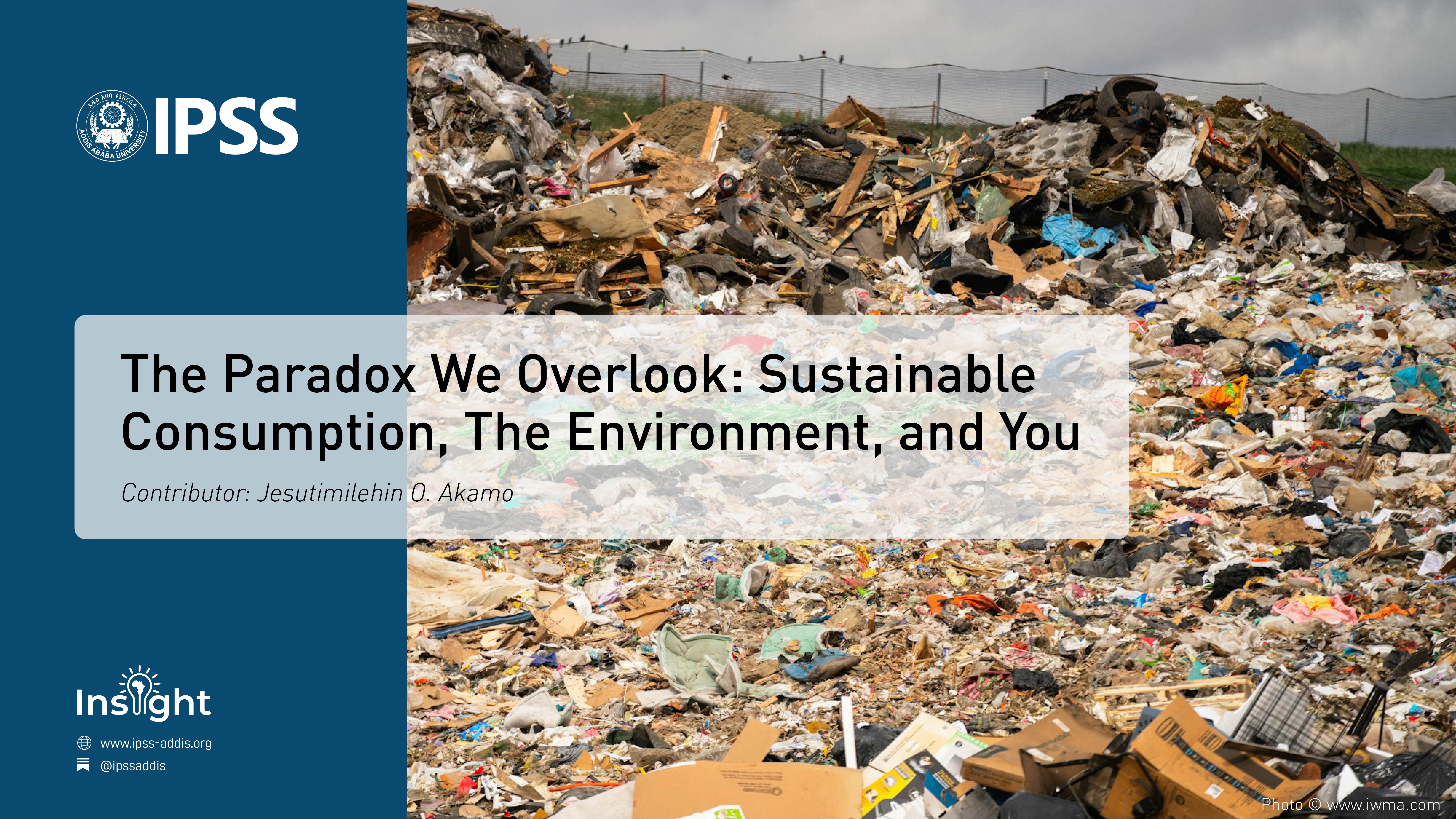
Regarding waste, consider this: over 400 million tonnes of plastic are produced worldwide every year, and less than 10% is recycled, according to the United Nations. The remaining 90% are used once and dumped as waste. Many find their way to the ocean, sewage systems, drainage systems, and so on. Amidst this, everyone likely uses about 20 million tonnes of plastic per year. While you may think, “I am just one person amidst over 8 billion people on earth”, it is better for the environment if we think in terms of value. For example, given the volume of plastic we consume yearly, you should consider yourself part of the value chain to reduce demand for plastic, which drives supply and, in turn, plastic waste. One person might not make much difference, but 50 million people can.
From ancient Yoruba proverbs, I observed that the idea of environmental sustainability is not imported. They understood it before it became a buzzword in the debate on protecting the environment, substantiating what Chuka Albert Okoye wrote about in a 2014 article with African Identities, titled “An evaluation of the evolved African conception of the environment.” According to Chuka, many African societies ploughed this path. They advocate that individuals ought to be mindful of the effects of the commodity they choose to consume and the rate at which they consume it.
One way to track the Yoruba’s worldview on the matter is through proverbs; here are two quick examples. The first example is “Má torí èní ba òla jé”, which may be translated as “Do not destroy tomorrow or the future because of today”. The second example is “Má je ayé omo mó tìe”, translated as “Do not use the wealth of your offspring(s) with yours”.
One way to understand the Yoruba’s view is how they conceptualise ‘Today’ as òni’ and ‘Future’ as òla’. ‘Today’ may refer to you, and ‘Future’ may refer to your offspring(s). Examples 1 and 2 notify the listener to protect the future when thinking of the present. It is future-oriented, placing the moral burden of protecting the ‘Future’ on ‘Today’. Through this, the Yorubas, among other things, put you at the centre of your actions and place the moral responsibility on you to ensure that you do not sabotage the future. Although not strictly followed, as was the case in old times, anyway, it attempts to discourage harmful accumulation and consumption while promoting futuristic thinking.
To date, many political leaders and monarchs in southwest Nigeria do not encourage the extractive industry on this pretext, and it has been that way since post-independence Nigeria. They believe that humans are not supposed to squander or misuse what future generations need to live decent lives, and that if something must be used, it should not harm the future. This construction among the Yoruba allowed for the subtle regulation of community members’ wants and desires and of how they pursued them. For the Yoruba, protecting the environment is premised on the security of their offspring, as Okoye’s earlier-referenced article noted.
At this juncture, a caveat is important. The Yoruba do not deny the self-interest of individual members of the community, nor do they ignore the accumulative nature of man. Rather, the point is that the culture attempts to socialise its members to prioritise sustainability and to constrain desires or actions that may lead to negative environmental consequences. This constitutes part of society’s expectations of a responsible member, which the Yoruba people may refer to as Omolúàbí.
We cannot get rid of the idea that we want to make profits and satisfy ourselves. However, we can manage the risks as responsible members of society by adjusting our approach to consumption [especially plastics], hence the call for a reflection.
It is almost, if not entirely, impossible to achieve that sustainability which we love to talk about if what we take from the environment continually exceeds its capacity to replenish itself. It is also impossible to achieve sustainability if the production and use of harmful materials, such as plastics and other toxic and destructive materials, increases rapidly, without recycling or proper disposal systems. Because of this, I call on all members of society to reflect on these simple questions:
Am I producing sustainably?
Am I consuming sustainably?
Does my waste disposal harm the environment?
Bear in mind that you are either a producer or a consumer, or both. No human is ever none.
Disclaimer: The views expressed in this Insight reflect the perspectives of the contributor and do not necessarily represent the official position of Institute for Peace and Security Studies.
 |
Contributed by Jesutimilehin O. Akamo Research and Policy Analysis unit Coordinator |