
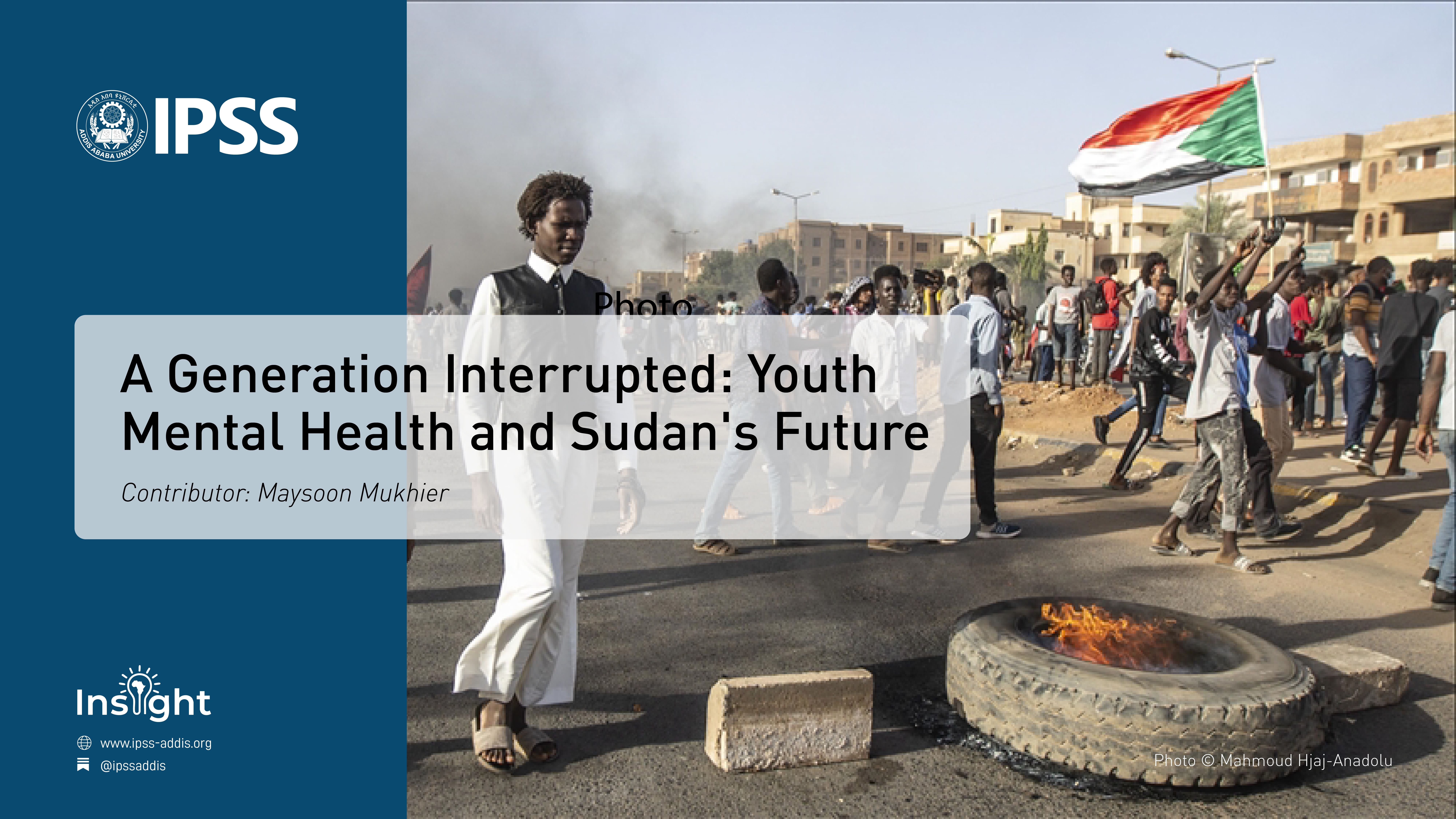
Aging generals and career politicians have contested for power in Sudan for three years following the outbreak of violent conflict between the Sudanese Armed Forces (SAF) and the Rapid Support Forces (RSF) in April 2023. Yet, a critical crisis remains neglected amidst ongoing peace talks: the psychological toll of conflict on Sudan’s youth. In a country where more than 60% of the population is under the age of 25, the young generation is not merely a demographic category but are rather the primary architects of Sudan’s future stability, economic development, and social cohesion.
Amidst challenges of returning to a peaceful and democratic transition alongside widespread infrastructural damage, disrupted social services, and debt, one of the most neglected casualties is the mental health of young Sudanese citizens. This neglect is not only a humanitarian concern, but a structural threat to long-term peace, governance, and development. It can lead to catastrophic impacts on the country’s foundation by depleting its current and future human capital – the cognitive, emotional, and physical energy required for socio-economic development. In a post-conflict reconstruction phase, labour does not amount merely to physical presence but also to the cognitive agency and emotional resilience required to innovate and lead. Therefore, without a psychologically resilient youth, Sudan risks falling behind in the global race for innovation, technological advancement and sustainable development. In doing so, the country risks losing the adaptive capacity required to modernise governance and to respond to evolving challenges.
In this context, paying attention to the mental well-being of the youth in policy planning and governance processes ensures Sudan does not inherit a future it is too exhausted to lead. As such, Sudan’s youthful demographic structure implies that trauma inflicted by state and non-state actors is a collective crisis, not just a series of personal tragedies. Young citizens have been subject to violence, political suppression, and displacement across different regions in Sudan both before and after the 2023 conflict.
The Human Cost of Conflict
As Sudan’s conflict enters its fourth year following the failure of a democratic transition, an estimated 14 million people have been forced to flee, including 9 million internally displaced and 4.4 million across borders. Access to education has also been largely disrupted with over 8 million children, making up nearly half of the country’s school-aged children, reported to be out of school. Moreover, one in three schools have been reported to be damaged or destroyed in what has been described as one of the worst education crises in the world. According to Save the Children, the most affected region in terms of education is North Darfur state with a mere 3% of more than 1,100 schools being open. West Kordofan, South Darfur and West Darfur followed with the lowest number of schools functioning at 15%, 13% and 27%, respectively. It is estimated by the United Nations that there has been a 288% increase in the number of gender-based violence (GBV) survivors seeking support between December 2023 and December 2024, with alarming reports of the abduction of girls and women during raids amounting to conditions of sexual slavery and enslavement.
A cross-sectional study by Awad et al. examining the mental health of displaced school-aged children (6-18 years) in River Nile State found that 68% of respondents felt frequently sad, 61% had difficulty concentrating, 57% had frequent headaches or stomach aches, 52% struggled with sleeping or nightmares, 73% felt anxious, and 29% had diagnosed conditions such as depression and post-traumatic disorder (PTSD). Other research that has examined the prevalence of generalised anxiety disorder (GAD) among 855 Sudanese adolescents (13-18 years) after the conflict found that 50.8% of participants had moderate GAD symptoms, while 28.9% reported mild GAD symptoms. Notably, female participants reported twice as high a prevalence of moderate GAD and a higher percentage of the severe GAD category compared to their male counterparts, indicating a significant gendered dimension to psychological distress.
On the one hand, adversity can foster social bonds, resilience and community based values, as demonstrated by the youth-led grassroots provision of humanitarian needs through Sudan’s Emergency Response Rooms (ERRs) – recipients of the 2025 Rafto Prize. On the other hand, mental health symptoms that are related to violent environments including feelings of grief, flashbacks, intrusive thoughts, bodily symptoms, difficulties in emotional regulations and substance abuse, can impact individual and collective well-being in the long-term if unaddressed. This can impair the realisation of social cohesion, social justice and the overall ability to positively contribute to society. Thereby creating obstacles to peace and sustainable development. The psychological impact of conflict-related trauma on national peace and security and sustainable social cohesion, is especially concerning when considering the use and exposure of children (not uncommonly from underprivileged backgrounds) to extremely violent battlefields. Sudan Human Rights Hub and Genocide Watch have reported the use of child soldiers in Sudan by both the RSF and SAF.
It is therefore imperative to recognise the differentiated impact of violence on youth, considering gender, socio-economic class, and even geography. For instance, a working-class young person from the peripheries may not have access to the same opportunities to recover from the displacement, disruption of education and/or conflict-related traumatic events as a middle- or upper-class counterpart from Khartoum, due to unequal access to resources, services or support systems. These disparities are rooted in long-standing inequalities shaped by decades of Khartoum-centric governance and post-colonial patterns of exclusion. Similarly, applying a gender-sensitive lens in peacebuilding is essential given the difference in experiences and societal stigmas experienced by girls and young women. Equally, the psychological realities of child soldiers differ profoundly to those of civilian youth not associated with armed groups – thereby raising complex questions around reintegration, stigma, and long-term social inclusion.
What emerges is the urgent need to develop targeted strategies to address the nuances of these layered realities within Sudan’s peacebuilding and post-conflict reconstruction process. In practice, this requires rethinking national priorities to position mental health and youth agency not as secondary concerns, but as a foundation for long-term stability and collective social recovery from the experienced violent conflicts in Sudan’s post-colonial history. This includes integrating a trauma-informed education strategy, where schools serve as psychosocial support hubs upon return to normalcy in pupil attendance, supported by adequately trained and financially compensated teachers. Importantly, there must be greater efforts for the economic reintegration of children and youth formerly associated with armed forces through vocational training and income generation projects, reinforced by counselling interventions. Finally, the peace process must prioritise meaningful youth political participation in decision-making, to avoid further repression of young people and to reinforce a more balanced representation reflecting the realities and needs of young people.
It is imperative that the peacebuilding process is not monopolised by an aging political elite, but instead to become inclusive of young citizens not only through descriptive representation but through true, substantive representation. The physical and mental wellbeing of young Sudanese people is not merely a human rights issue, it is a determinant of the quality and efficiency of the country’s human capital and therefore its economic productivity, governance capacity, and long-term development trajectory. Without an educated, healthy, and civically engaged youth, Sudan risks perpetuating historical structural inequalities, conflict, and undermining prospects for accountable governance and state-resource management. A cultural transformation towards mental health awareness, power-sharing and youth empowerment, may therefore present one of the key pathways towards constructing a new social contract that serves the broader population rather than a select few.
Disclaimer: The views expressed in this Insight reflect the perspectives of the contributor and do not necessarily represent the official position of Institute for Peace and Security Studies.
 |
Contributed by Maysoon Mukhier Researcher |